⏳ This is an 8 minute read 📚
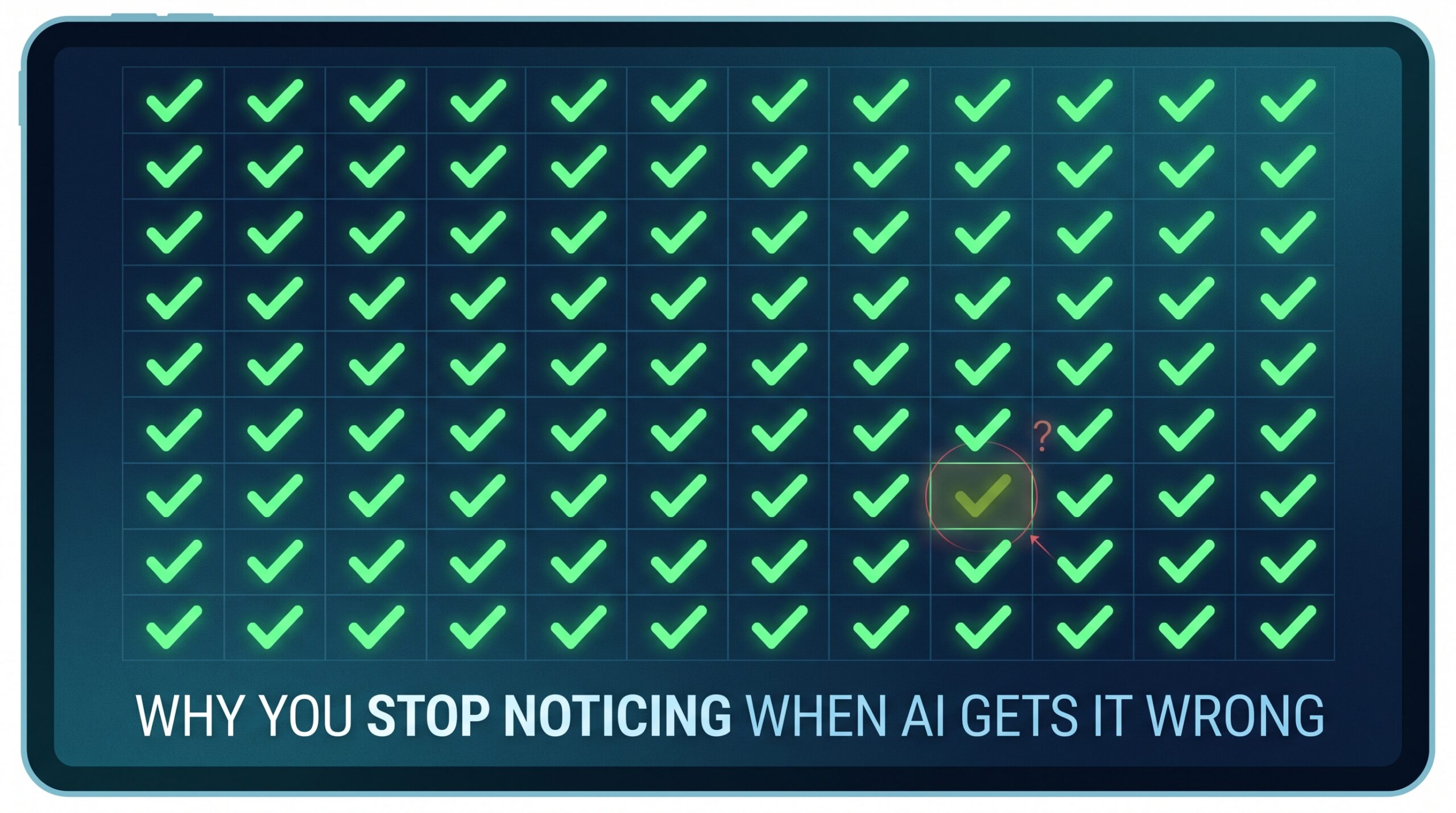
Here’s the risk nobody’s talking about with AI in finance. It’s not that the tool gets something wrong. It’s that you stop noticing when it does.
That’s the quiet version of the problem. You ask AI to build a variance analysis or draft a forecast narrative, it comes back looking clean and confident, and you move on. No red flags, no second look. Do that enough times and you’re not thinking less because you got worse at your job. You’re thinking less because the tool made it so easy to think less.
Bryan Lapidus, FP&A Practice Director at the Association for Financial Professionals (AFP), put a name on this a few weeks back. He posted a provocative take on things, arguing that the future of financial analysis comes down to two disciplines: writing a strong prompt on the front end, and checking the output thoroughly on the back end.
He built two checklists to back it up, with ten items each. One for setting up a strong prompt. One for stress testing what comes back. They’re good checklists, and I recommend reading his full article and checklists here.
As good as a checklist is, you still have to look it up unless you memorize it…or do you? What if you had a cheat code to help you remember the checklist without memorizing by repeating it over and over? That’s where a little memory tool called a mnemonic comes in.
I’ve worked with Bryan and many of his colleagues at AFP for years, and I guess I’ve become known for using mnemonics in my teaching. So, Bryan asked me if I could come up with a mnemonic to help people remember his checklists. He already built himself a starter version using AEIOU. Again, go read his article and get the full story and his checklist.
I couldn’t leave that unanswered. Here’s what I built, including the first attempt I threw away and why, and where I used Claude AI along the way.
What a mnemonic actually is, and why it matters here
A mnemonic is a memory aid.1 It’s a technique that makes information easier to hold onto and pull back up later by tying it to something more familiar, more meaningful, more vivid, or just better organized than the raw information on its own. “Righty tighty, lefty loosey” is a mnemonic. You’ve probably been using these since third grade without ever putting a name on what they were.
Here’s why they matter more than people give them credit for. Your short-term memory can only hold so much at once, and most research puts that number around seven items before things start falling out the back.2 Ever wonder why phone numbers are seven digits? Now you know.
Ten checklist items is already past that limit, which is exactly why a good checklist is easy to respect and hard to actually recall under pressure. Group those ten items into one word, though, and you’re asking your brain to hold onto one thing instead of ten. That’s the whole trick. Not memorizing more. Carrying less.
One thing needs to be said plainly here, before we go any further: a mnemonic is not a substitute for learning the checklist. It’s a way to recall the checklist once you’ve actually learned it. Read Bryan’s ten items first. Understand why each one is on there. Then let a word like BRIEFED or STRESS do the remembering for you after that. Skip the learning step, and all you’ve got are two clever words that don’t mean anything yet.
What makes a mnemonic actually work
Not every acronym is a mnemonic. Here’s what I hold one to before I’ll trust it:
- It’s a word you can say out loud, not a code you have to decode. If you have to stop and figure out what it means, it didn’t save you any work.
- It doesn’t fight something you already know by heart. If people already have a different meaning locked in for those letters, your version loses. Every time.
- No bolted on extras. The second a mnemonic needs a “plus one more thing” tacked onto the end, that tacked on piece is the first thing you’ll forget under pressure.
- Each letter points to one clear idea. That idea doesn’t have to be exactly one item from your original list. Sometimes two items are really the same idea wearing different clothes, and bundling them under one letter is good memory work, not cutting corners. What a letter can’t do is cover two unrelated ideas. That’s not bundling. That’s just confusing.
- Bonus points if the word does the job it’s naming. The best mnemonics don’t just label the action. They are the action.
That last one is why STRESS ended up being the stronger of my two words. Keep reading.
Case study: the front end (or, how I almost shipped a bad one)
I used Claude AI to get a first draft moving. First swing: 5W1H+G.
I looked at it and knew right away it wasn’t going to hold up. Three problems were apparent, right out of the gate:
- It’s a formula, not a word. You can’t say “5W1H+G” the way you say “stress.” Nobody’s walking into a meeting and casually dropping that.
- 5W1H (Who, What, When, Where, Why, How) is already spoken for. Journalists use it. Auditors use it. I was quietly reassigning what “How” meant, which means anyone who already knows the real version was going to misremember mine.
- The “+G” was a giveaway. I had two ideas, assumptions and constraints, that didn’t fit anywhere else, so I taped them onto the end. That’s the bolted on extra problem from criterion three, and I’d built it into version one without even trying to.
Here’s the part that stings a little. Bryan’s own back end checklist would have caught this before I ever wrote it down. Question one on his list: what assumptions are unstated? I was assuming nobody would notice I’d hijacked 5W1H’s real meaning. Question five: does this pass a CEO sniff test? Mine didn’t, and I’m the one who wrote it. I had the exact tool to catch my own mistake sitting right there in his article, and I didn’t use it. I caught the problem the old fashioned way, by eyeballing my own work and not liking what I saw. Kind of funny, and a pretty good argument for actually running the checklist instead of just admiring it.
Back to the drawing board. This time I asked Claude a different question. Instead of starting from the ten items and forcing letters out of them, what’s the one word that is the action of writing a good prompt?
A good prompt is a briefing. So: BRIEFED.
| Letter | Covers |
|---|---|
| Backstory | Why now, what decision this is actually for |
| Result | What success looks like |
| Interested party | Who’s going to read this |
| Edges | What’s in scope, how detailed, over what time window |
| Footing | What you’re assuming, what’s limiting you |
| Eyes | How you want it to think about the problem |
| Delivery | What shape you want the answer in |
Real word. No collisions. No bolted on extras. Every letter earns its spot.
Case study: the back end (the one that worked the first time)
The back end checklist is about stress testing your own conclusions instead of admiring them. I ran the same process here that I used on the front end. Asked Claude for a first pass, then checked what came back against my own five criteria before I trusted it.
This time, the first version held up. STRESS.
| Letter | Covers |
|---|---|
| Sniff test | Does this pass the smell test? Is it directionally right? |
| True drivers | What’s assumed but unstated? Is this cause, or just correlation? |
| Resilience | What would break this? What changes the answer if the frame shifts? |
| Exposed gaps | What’s missing? Is the precision here overstated? |
| Stakeholders | Whose incentives are baked into this answer? |
| Sequel | What’s the next question this should raise? |
Four of those six letters are covering two related questions each, not one. Sniff test covers both “does this feel right” and “is it directionally right.” Same idea, two phrasings. That’s the good kind of bundling from criterion four. Nothing under one letter is doing double duty on two unrelated ideas. It’s honest.
One thing I’ll say straight. STRESS is a great tool for remembering the six categories to check. It’s not a literal index to all ten original questions. If you need the exact wording of “is precision overstated,” you’re still going to want the source list.
Putting it together
BRIEFED going in. STRESS tested going out.
That’s the whole system in five words. Write the prompt like you’re briefing someone who’s never seen the problem. Then treat whatever comes back like it needs to survive an audit, not a compliment.
One example of a bigger idea
This is one small case study, but it’s really about a bigger habit. Taking a good idea and making it something you’ll actually use under pressure, six months from now, without the reference document open. That’s most of what I teach. The CLEAR Communication OS (Operating System), and everything under it, exists because a framework nobody can recall when it matters isn’t a framework. It’s a document.
If you’re building your own AI habits into your finance work, start there. BRIEF it well, then STRESS test what it hands back. Try it on your next model, your next variance explanation, your next board deck narrative, and let me know what breaks.
1. Definition from a Perplexity AI response to the query “define mnemonic,” 2026: a mnemonic is a memory aid, a technique that makes information easier to encode, retain, and retrieve by linking it to something more familiar, meaningful, vivid, or well organized.
2. The commonly cited estimate for short-term memory capacity, roughly seven items, traces back to psychologist George Miller’s 1956 paper “The Magical Number Seven, Plus or Minus Two.”